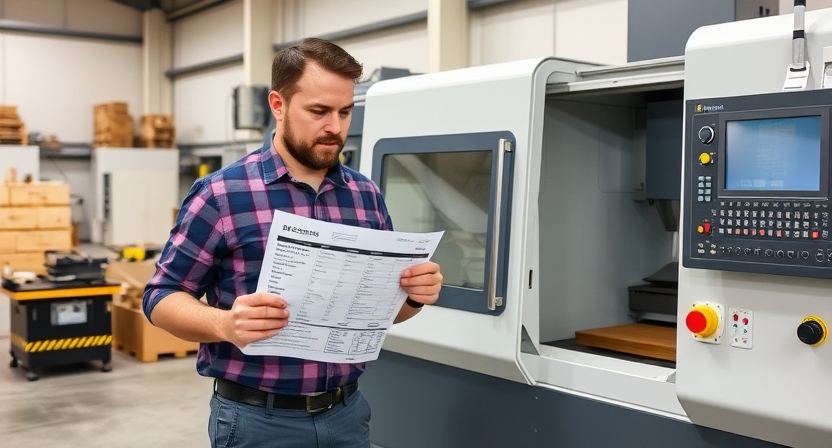
When buying industrial woodworking machinery, the most important specifications are the ones that match the actual production task. Working dimensions, motor or spindle power, feed speed, machining accuracy, tooling options, production capacity, automation features, material compatibility, and maintenance requirements should all be evaluated before selecting a machine.
A specification with a larger number is not automatically better. The goal is to choose equipment that can process the factory’s real materials and components efficiently while fitting into the surrounding production workflow.
Start With the Workpiece, Not the Machine
Before comparing machine specifications, define what the equipment will produce.
A factory should identify the materials it processes, typical component dimensions, maximum workpiece size, required operations, batch sizes, and expected production volume.
For example, a cabinet manufacturer processing MDF and plywood panels has different requirements from a solid-wood factory producing chair legs or moulded furniture components.
Important questions include:
- What materials will the machine process?
- What are the minimum and maximum workpiece dimensions?
- Which machining operations are required?
- How frequently will product designs change?
- What production volume must the machine support?
- Which processes happen before and after this machine?
These answers provide a practical basis for comparing specifications.
Check Working Dimensions and Machine Capacity
Working dimensions describe the physical size of material or components that a machine can accommodate.
For a CNC router, this may include the usable working area and relevant axis travel. A panel saw may be evaluated according to supported sheet dimensions and cutting capacity. A sander requires an appropriate working width and thickness range.
Manufacturers should compare these limits with both their common components and the largest workpieces they reasonably expect to produce.
Buying equipment that cannot accommodate important components creates an obvious restriction. However, substantially oversizing a machine can also occupy more factory space and add capabilities that the production process may rarely use.
Motor and Spindle Power Need Context
Power specifications matter, but they should be interpreted alongside the intended application.
On CNC woodworking machines, spindle characteristics influence the types of cutting and routing operations the equipment can perform. Saws, sanders, moulders, and other machines have their own motor requirements.
The appropriate power depends on factors such as material, cutting depth, tooling, feed conditions, and the type of operation.
Therefore, manufacturers should avoid comparing machines solely by choosing the highest motor or spindle figure. A better question is whether the machine has suitable power and operating characteristics for the required process.
Feed Speed Affects More Than Output
Feed speed describes how quickly a workpiece or machining process advances, depending on the machine design.
It can influence production capacity, but maximum feed speed should not be treated as guaranteed production output.
Actual operating speed may depend on material, tooling, component complexity, machining quality, operator setup, and downstream capacity.
For example, increasing the output of one machine provides limited value if components immediately queue at the next process.
When buying industrial woodworking machinery, compare practical workflow requirements rather than evaluating maximum speed in isolation.
Accuracy and Repeatability Matter in Furniture Production
Accuracy describes how closely machining corresponds to the required dimensions or positions. Repeatability concerns the machine’s ability to reproduce a process consistently.
Both can matter when producing furniture components that must fit together during assembly.
Cabinet panels may require correctly positioned drilling patterns. CNC-machined components may need consistent profiles or grooves. Solid-wood parts may require dimensional consistency before assembly or finishing.
Buyers should understand how the manufacturer specifies machine accuracy, under what conditions the specification applies, and what setup or calibration procedures are required to maintain it.
Examine Tooling and Machining Flexibility
A machine should support the tools required for its intended operations.
For CNC equipment, this may involve router bits, drills, cutters, tool holders, and automatic tool-changing options. Other woodworking machines may require specific saw blades, sanding abrasives, moulding cutters, or processing heads.
Tooling flexibility becomes especially important when a factory manufactures multiple product types.
A CNC system that needs several tools during one component cycle may benefit from automatic tool changing. In contrast, a repetitive operation using one primary tool may not require the same configuration.
Buyers comparing suppliers such as SAMACH woodworking machinery should match available machine configurations to their own component geometry, materials, tooling needs, and production sequence rather than selecting equipment from specifications alone.
Consider Automation at the Workflow Level
Automation can involve much more than the primary machining operation.
Depending on the production system, automation may include material loading, feeding, positioning, tool changing, labeling, unloading, conveying, sorting, or communication with production software.
The useful level of automation depends on the factory.
A high-volume operation may benefit from reducing repetitive material handling. A smaller custom manufacturer may prioritize flexibility and simpler changeovers instead.
The key question is where automation removes a genuine production constraint.
Factories should identify bottlenecks and labor-intensive steps before deciding which automated features provide practical value.
Production Capacity Must Match Other Machines
Machine capacity should be considered as part of the complete production line.
Suppose a panel-processing machine produces components faster than the factory’s edge bander or drilling station can process them. The additional output may simply create a queue of unfinished components.
Likewise, increasing machining capacity without sufficient material handling can lead to delays around loading and unloading.
A balanced line coordinates cutting, CNC processing, drilling, edge banding, sanding, finishing, and assembly according to the factory’s actual products.
For this reason, purchasing decisions should consider system capacity rather than only individual machine capacity.
Check Material Compatibility
Industrial woodworking factories may process solid wood, MDF, plywood, particleboard, laminated panels, engineered wood, or other materials.
Not every machine configuration is equally appropriate for every material and operation.
Buyers should confirm supported material dimensions and thicknesses while also considering suitable tooling, feed conditions, workholding, dust extraction, and surface requirements.
Material compatibility is especially important for factories that process several types of wood products on the same equipment.
Do Not Overlook Maintenance Requirements
Maintenance affects how a machine fits into long-term factory operations.
Before purchasing, manufacturers should understand routine lubrication, cleaning, calibration, tooling maintenance, consumable requirements, dust-management needs, and access to serviceable components.
It is also useful to consider the availability of technical documentation, replacement parts, and appropriate service support.
A technically capable machine can still create operational difficulties if routine maintenance does not fit the factory’s resources or production schedule.
Compare Specifications Against a Real Production Scenario
The most effective machinery comparison uses an actual component or production scenario.
Instead of asking which machine has the strongest specification sheet, define a representative job: material type, dimensions, machining operations, tooling, expected batch size, and required downstream processes.
Then compare whether each candidate machine can complete that work appropriately.
This approach helps separate useful specifications from features that may have little relevance to everyday production.
The right industrial woodworking machine is therefore not necessarily the fastest, largest, or most automated option. It is the machine whose working dimensions, power, feed characteristics, accuracy, tooling, capacity, automation, material compatibility, and maintenance requirements align most closely with the factory’s real manufacturing process.