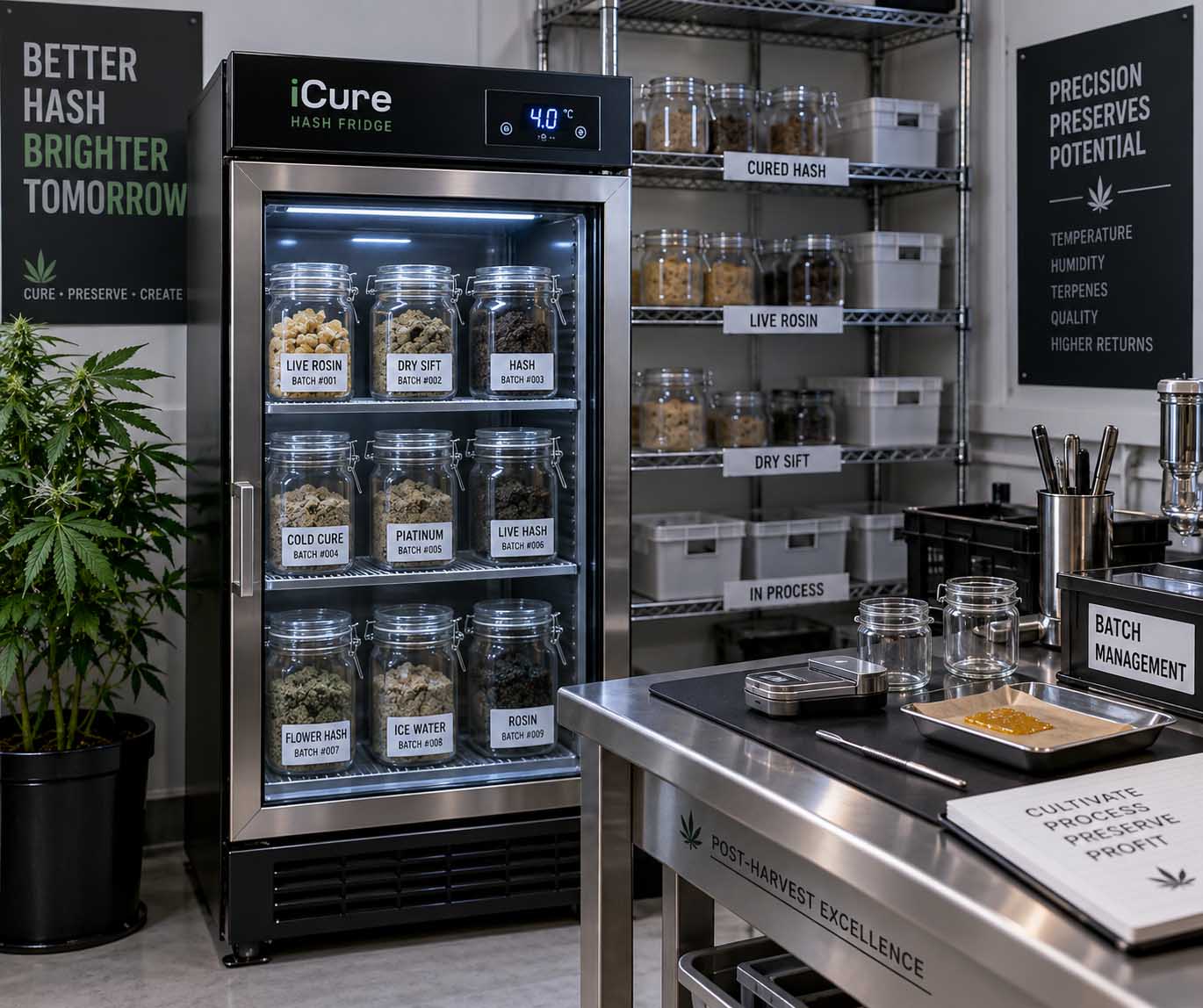
Professional cannabis concentrate storage equipment should provide more than a cold place to keep hash or rosin. A suitable system should support controlled temperatures, stable operating conditions, organized batch storage, practical access, appropriate capacity, and a workflow that matches how concentrates are handled after processing.
The right equipment depends on the product being stored and the operation using it. A small rosin producer may have very different requirements from a facility managing multiple concentrate batches every day.
Start With the Intended Storage Purpose
Before comparing equipment, define exactly what the storage unit needs to do.
Hash, fresh press rosin, cured rosin, and other concentrates may enter storage at different stages of production. Some material may need short-term holding before the next processing step, while finished batches may require longer-term preservation.
Storage should also be distinguished from active curing.
Curing intentionally places a concentrate under selected conditions to support development or maturation. Storage primarily aims to maintain material after it has reached the desired stage.
Knowing which function is required prevents processors from choosing equipment based only on appearance or general refrigeration capability.
Temperature Control Should Match the Workflow
Temperature control is one of the first features to evaluate.
Rather than simply asking whether a unit becomes cold, consider whether its controls fit the conditions required by the products being stored.
A professional workflow benefits from clearly defined storage procedures. Staff should know where products belong, what conditions are intended, and how batches should be handled when they enter or leave storage.
The equipment should make those procedures easier to follow rather than adding unnecessary complexity.
Look for Temperature Stability
Temperature setting and temperature stability are related but different considerations.
A unit may allow the operator to select a particular setting, but professional storage also depends on maintaining appropriately controlled conditions during normal operation.
Frequent door opening, overloading, poor organization, or placing equipment in an unsuitable environment can all complicate storage management.
Processors should therefore consider how the unit will perform within the actual facility, not just the selected temperature shown on its controls.
Choose Capacity Based on Real Batch Requirements
Bigger is not automatically better.
The useful capacity of storage equipment depends on the number and size of containers the operation needs to manage.
A processor can estimate requirements by considering:
- Typical batch volume
- Number of cultivars or products stored simultaneously
- Container dimensions
- Short-term versus reserve inventory
- Frequency of product access
- Expected production growth
There should be enough room to organize containers without creating an unnecessarily oversized system for the operation.
At the same time, choosing equipment with barely enough capacity can make organization difficult as production increases.
Organization Is a Professional Storage Feature
Good storage equipment should make individual batches easy to identify and retrieve.
A facility may simultaneously hold fresh press rosin, cured rosin, hash, test batches, reserve inventory, or products awaiting another processing step. Mixing containers without a clear system increases the chance of unnecessary handling.
Shelving and usable interior space should support logical separation.
Labels can include information such as batch identification, cultivar, processing date, storage date, and current production status.
This creates a connection between physical storage and batch records.
Consider Dedicated Concentrate Storage
A general household refrigerator may provide cooling, but professional processors often need a space dedicated specifically to concentrate handling.
Dedicated storage avoids mixing production material with unrelated items and makes it easier to establish consistent operating procedures.
When evaluating purpose-built options, the Pro Muta Mini Fridge represents the type of compact temperature-controlled equipment intended for professional cannabis, hash, rosin, and concentrate workflows.
The important consideration is not simply the product name. Operators should determine whether the equipment’s intended use, controls, available space, and workflow compatibility match their own processing requirements.
Think About How Often the Door Will Be Opened
Access frequency is easy to overlook when selecting storage equipment.
If staff need to retrieve products throughout the day, frequently used material should be organized so it can be located quickly. Searching through multiple containers every time the door opens makes the process less efficient.
Separating working inventory from reserve batches can help.
Frequently accessed products can remain easy to reach, while longer-term material can stay organized separately and experience less unnecessary handling.
This approach can be particularly useful when one storage unit serves several concentrate types.
Containers and Storage Equipment Work Together
Even well-controlled storage equipment cannot compensate for unsuitable concentrate containers.
Containers should be appropriate for the material, close securely, and fit efficiently within the available storage space.
Operators should consider container dimensions before selecting equipment. A unit may appear spacious but offer less practical capacity if the shelving arrangement does not suit the jars or containers actually used by the business.
Storage planning should therefore evaluate the equipment and packaging system together.
Consider Cold-to-Warm Handling
Professional storage does not end when a jar is removed from the unit.
Cold concentrate containers may encounter warmer and more humid air when brought into a processing room. Under suitable conditions, moisture can condense on cold surfaces.
For this reason, storage procedures should include a defined removal process.
Keeping a cold container sealed while it adjusts toward appropriate handling conditions can reduce direct exposure of cold internal surfaces to warmer ambient air.
The storage system should make it practical for staff to follow this procedure consistently.
Cleaning and Workspace Integration Matter
Storage equipment should fit naturally into the processing environment.
Consider where the unit will be located, how easily staff can access it, how containers will move between processing and storage areas, and how the interior can be kept organized.
A clean, dedicated storage area can simplify routine batch management.
Operators should also consider the surrounding room. Equipment placed in an unsuitable location may face different operating conditions from a unit installed in a stable professional workspace.
Match Equipment to the Complete Process
The best storage choice is one that fits the wider post-harvest system.
A solventless workflow may include ice-water washing, filtration, drying, rosin pressing, curing, and final storage. Capacity at each stage should make sense relative to the others.
For example, increasing pressing capacity without considering available curing and storage space can create a downstream bottleneck.
Professional cannabis concentrate storage equipment should therefore be selected according to actual production volume, temperature-management needs, container system, access frequency, available workspace, and future workflow requirements. When these factors are considered together, storage becomes an organized part of concentrate processing rather than simply a place to put finished jars.