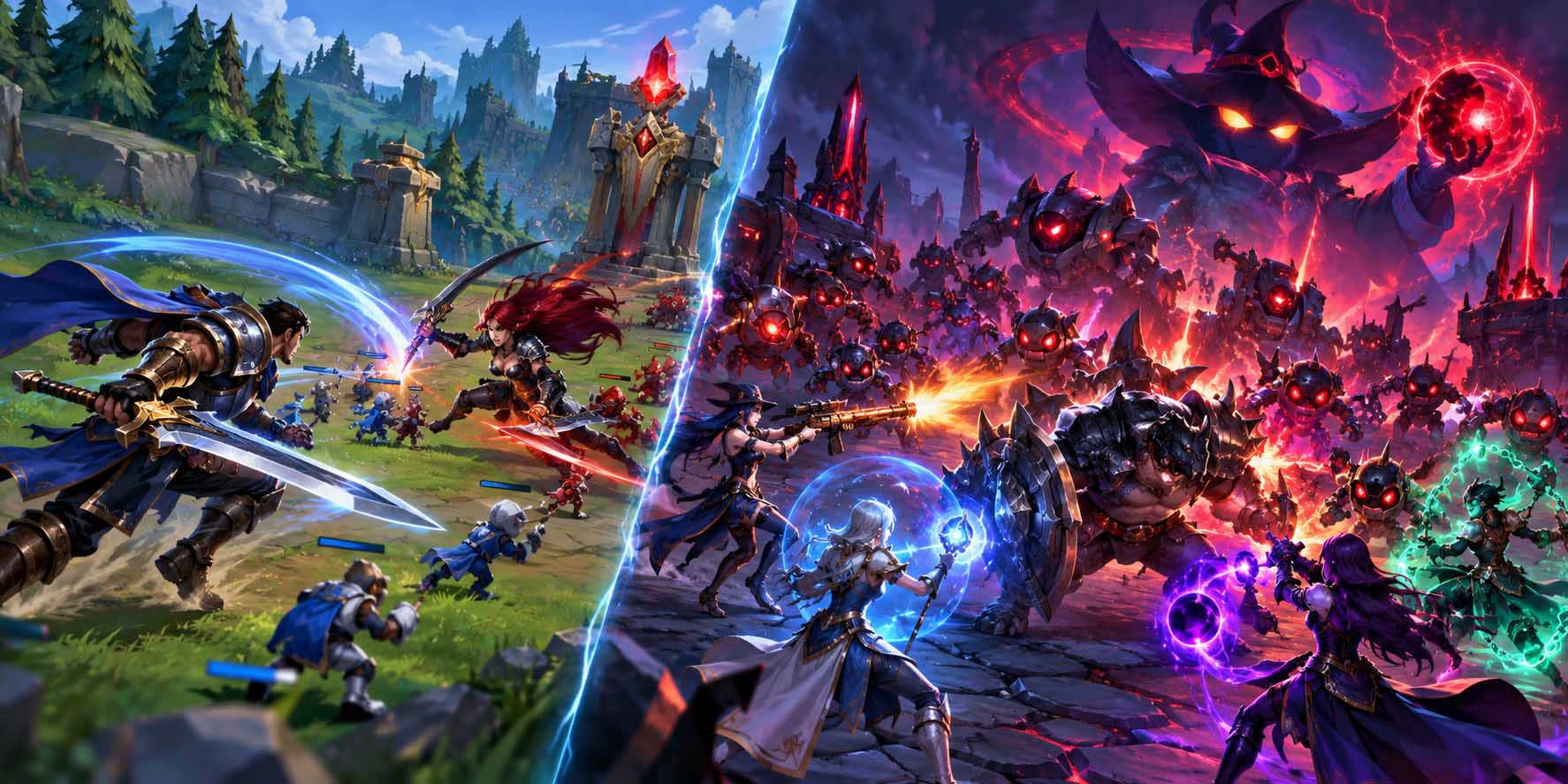
PvE champion selection in League of Legends requires a different mindset from choosing a strong solo queue pick. A champion can perform extremely well against human opponents yet be less suited to repeated AI waves, prolonged encounters, or team-based PvE objectives. Doom Bots rewards qualities such as reliable wave clear, sustained damage, survivability, crowd control, and team utility in ways that do not always match standard PvP priorities.
The important question is therefore not simply, “Is this champion strong?” It is, “Are this champion’s strengths useful for the challenges this PvE mode creates?”
Why PvE Champion Selection Differs From Solo Queue
Solo queue and PvE place champions in different competitive environments.
In normal PvP, players face human opponents who adapt their positioning, strategies, builds, and decision-making throughout a match. Individual matchups, lane pressure, roaming, dueling, picks, and objective control can all influence champion value.
Doom Bots changes those priorities.
The team faces AI-controlled enemies and must handle repeated PvE pressure. This can increase the practical importance of clearing groups efficiently, surviving extended encounters, controlling multiple threats, and maintaining useful damage over time.
A champion designed to excel in short PvP exchanges may therefore offer less value than expected if its strongest qualities do not translate naturally into these situations.
Solo Queue Strength Often Depends on Human Matchups
Some champions become especially effective in PvP because they can exploit mistakes made by human opponents.
They may punish poor positioning, create favorable one-versus-one situations, surprise isolated enemies, or gain advantages through lane pressure.
These are valuable competitive strengths, but their importance can change against AI-controlled enemies.
For example, a champion whose identity depends heavily on catching one vulnerable opponent may have fewer opportunities to use that strength when the team’s immediate problem is a large group of advancing enemies.
The champion has not suddenly become weak. The environment simply values different attributes.
This distinction is central to understanding PvE champion selection.
Wave Clear Has Greater Strategic Importance
Doom Bots can create pressure through groups of enemies rather than isolated PvP exchanges.
That makes efficient wave clear highly useful.
Champions with accessible AoE damage can affect several enemies at once, helping the team prevent waves from becoming increasingly difficult to manage.
This does not mean every good PvE champion must specialize in AoE.
Instead, the team needs enough wave-clearing capability across its composition. A champion that provides little group damage should ideally compensate through another valuable function such as sustained single-target damage, frontline strength, crowd control, or utility.
This creates a different evaluation system from simply asking which champions currently perform well in solo queue.
Burst Damage and Sustained Damage Solve Different Problems
Burst damage is powerful when a target needs to be removed quickly.
In PvP, eliminating an opposing champion in a short window can immediately change a fight. PvE encounters can place greater emphasis on repeated or prolonged damage opportunities.
A champion capable of maintaining consistent output may therefore become especially useful.
Sustained damage allows a player to continue contributing after the first ability rotation. This can help during extended encounters and against tougher targets that cannot simply be removed through one quick combination.
Burst still has value, particularly when specific threats need immediate attention. However, PvE teams benefit from having damage patterns suited to both short windows and longer fights.
Survivability Has Offensive Value in PvE
Survivability is often discussed as a defensive characteristic, but it also affects how much useful work a champion can perform.
A player who remains active can continue attacking, clearing waves, applying crowd control, or protecting teammates.
A champion forced away from the fight loses those opportunities.
PvE survivability can come from durability, healing, shielding, range, mobility, defensive abilities, or good positioning. Different champion classes achieve it in different ways.
This means a champion with slightly lower theoretical damage may sometimes provide more practical value if it can deliver that damage consistently under pressure.
Reliability matters.
Crowd Control Can Be More Valuable Than Another Damage Ability
Raw damage is easy to notice, but crowd control can change the structure of an encounter.
Slows, roots, stuns, knockups, and zoning abilities can prevent several threats from applying pressure at the same time. This creates safer opportunities for teammates to use their own damage.
For example, an AoE damage dealer becomes more effective when enemies remain grouped inside an ability’s area. A ranged champion gains additional attack time when approaching enemies are slowed.
Crowd control therefore acts as a force multiplier.
A champion may contribute less personal damage while increasing how effectively several teammates can operate.
That kind of contribution may not be reflected by how the same champion is evaluated in a typical solo queue matchup.
Utility Changes the Value of a Champion
Utility refers to useful team effects beyond straightforward damage.
Healing, shielding, movement assistance, zoning, protection, and control can all improve the team’s ability to function under pressure.
These abilities are particularly useful when they compensate for weaknesses elsewhere in the composition.
A fragile ranged damage dealer may perform much better with reliable protection. A frontline fighter can remain effective longer when supported by shields or healing. Wave-clear champions can apply their AoE damage more reliably when another player controls enemy movement.
PvE therefore encourages players to think about champion interactions rather than evaluating every pick independently.
A Strong PvE Pick Should Have a Clear Job
One useful way to evaluate a champion is to ask what responsibility it performs when the match becomes difficult.
Possible answers include:
- Clearing large groups
- Providing sustained damage
- Creating frontline space
- Controlling dangerous enemies
- Protecting vulnerable teammates
- Supporting the team through healing or shields
- Applying reliable boss pressure
- Helping the group reposition
If the champion has a clear and repeatable job, its value is easier to understand.
Problems arise when a pick is chosen primarily because it is popular or strong in standard League of Legends without considering what it contributes to Doom Bots.
For players comparing how familiar League champions translate into the mode, GamesInfoShop provides a Doom Bots-focused ranking resource that evaluates champion choices within the PvE context.
The important shift is from general champion strength to mode-specific usefulness.
Team Composition Can Change an Individual Champion’s Value
A champion does not operate in isolation.
Suppose a team already has excellent AoE wave clear but lacks durability. Adding another fragile wave-clear specialist may provide less value than selecting a champion capable of creating frontline space.
The opposite can also happen.
A team with several durable melee champions may benefit significantly from adding ranged sustained damage or a control mage.
This means the same champion can be a useful choice in one composition and an awkward choice in another.
PvE champion selection should therefore consider both individual strengths and existing team capabilities.
Specialized PvP Strengths May Translate Poorly
Certain qualities can be extremely useful against human opponents while contributing less directly to PvE objectives.
A champion may excel at split pushing, isolated dueling, surprise attacks, or exploiting specific lane matchups. Those characteristics can define the champion’s solo queue identity.
But Doom Bots may ask different questions.
Can the champion manage repeated enemies?
Can it stay effective under prolonged pressure?
Does it help control groups?
Can it contribute when the team needs sustained damage?
Does it offer something useful during major encounters?
If the answer to several of these questions is no, strong solo queue performance alone is not enough to make the champion an ideal PvE pick.
Familiarity Still Matters
Mode-specific strength does not mean players should ignore personal experience.
A familiar champion can sometimes be more effective than an unfamiliar theoretically stronger pick.
Knowing ability ranges, cooldown patterns, mobility options, and defensive tools reduces the amount of attention needed to control the champion. The player can then focus more closely on Doom Bots mechanics and positioning.
The practical goal is to combine familiarity with suitable PvE characteristics.
A comfortable champion that offers wave clear, survivability, sustained damage, or utility can be an excellent choice even if another pick appears stronger on paper.
Judge Champions by the Problems They Solve
Effective PvE champion selection starts by identifying the challenges the team needs to handle rather than importing a standard solo queue hierarchy into a different mode.
Wave clear helps manage groups. Sustained damage supports longer encounters. Survivability keeps important roles active. Crowd control creates safer opportunities, while utility strengthens teammates and improves the composition as a whole.
A strong solo queue champion can certainly also be an excellent Doom Bots pick, but the reason should come from how well its kit solves PvE problems—not simply from its reputation in normal competitive play.
The most useful approach is to evaluate champions according to their role, reliability, team synergy, and ability to remain effective across the different pressures that Doom Bots creates.